A cohort was established to examine the potential longer-term health effects associated with the oil spill exposure more than one year after the accident.A baseline survey was conducted in adults and children in 2009, 1 year after the oil spill. Follow-up surveys are being conducted biennially on adults, children, and adolescents.The baseline survey in 2009 enrolled 9,246 adults and 1,172 children and adolescents. Since then, biennial follow-up surveys are being conducted on approximately 800 to 1,200 people. In total, 19,830 participants were enrolled in this survey (adults: 14,396, children and adolescents: 5053, pregnants: 381).This study was approved by the Institutional Review Board of Dankook University Hospital, Cheonan, the Republic of Korea. Written informed consent was obtained from each participant before enrollment.
Cohort survey
- Adults: 2009, 2010, 2012, 2014, 2016, 2018
- Children and adolescents: 2009, 2011, 2013, 2015, 2017, 2019
Oil spill and human health effects
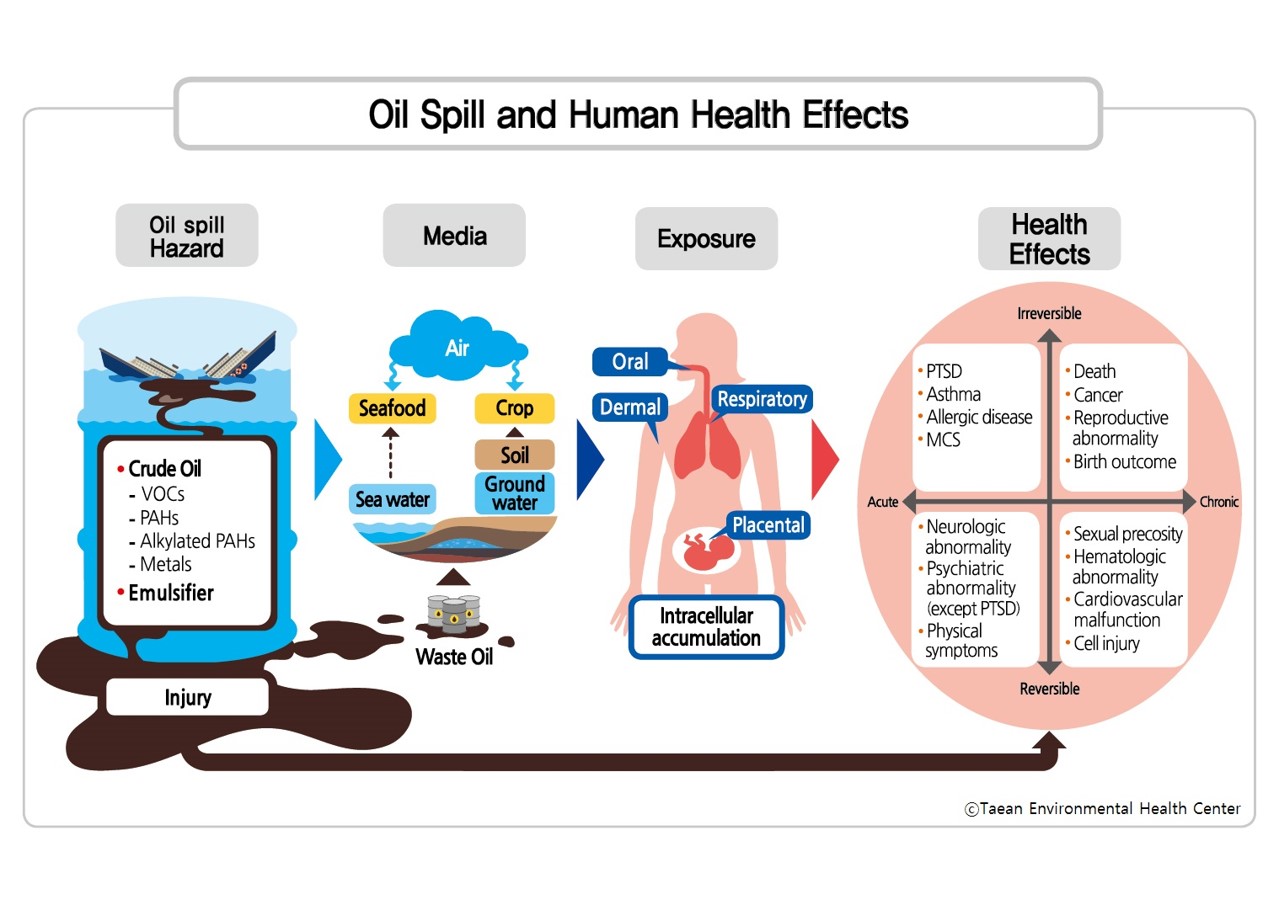
Crude oil may contain many contaminants such as VOCs, PAHs, and Heavy metals. Crude oil spills can enter the human body via various routes, including breathing, contact with the skin, and the atmosphere, ocean, and soil. Theoretically, the health effects caused by the oil spill can be divided into four categories (reversible vs. irreversible and acute vs. chronic) depending on the time of the occurrence of the disease and the recovery possibility.
- Acute and reversible: health effects arise at the initial stage of the accident, and recovers as time passes (neurologic abnormality, physical symptoms)
- Acute and irreversible: health effect arises at the initial stage of the accident, but continues for a considerable period of time [post-traumatic stress disorder(PTSD), Allergy, MCS]
- Chronic and reversible: health effect may not be discovered at the initial stage of the accident, but after several months or years, and it may recover soon or is diluted over time (sexual maturity, hematologic abnormality, cardiovascular malfunction)
- Chronic and irreversible: health effect occurs months or years after the accident, and continues for a lifetime (death, cancer, reproductive abnormality, birth outcome)